
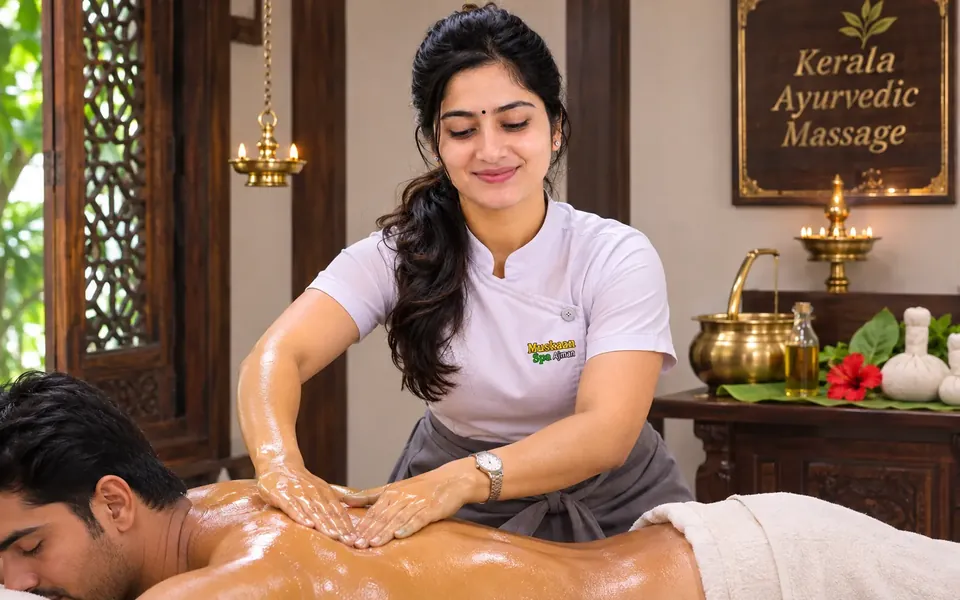
Deep tissue & sports massage at a glance
- Main focus
- Slow, firm pressure on specific tight areas
- Often chosen for
- Tight shoulders and upper back, after training
- Price
- 60 min: AED 99 · 90 min: AED 150
- What it is
- Slow, firm, focused pressure on tight muscles, shaped around your work or training
- Pressure
- Firm (adjusted to your comfort)
- Session and price
- AED 99 for 60 minutes and AED 150 for 90 minutes
- Best for
- Tight shoulders and upper back, gym-goers, drivers and desk workers
- Not suitable
- Recent injuries or some medical conditions. Check with your doctor first
- Where
- Muskaan Spa, Al Rashidiya 2, Ajman · open 24/7
What is deep tissue massage?
Deep tissue massage uses slow, firm, focused pressure to work into the deeper layers of muscle. Instead of covering the whole body evenly, the therapist spends more time on the areas that feel tight, often the upper back, shoulders, neck, lower back and legs. Strokes are slower than in a relaxation massage, and the therapist may use forearms, knuckles or elbows as well as hands.
The goal is simple. Many guests come to us saying, "I want someone to actually work on my shoulders." Deep tissue massage is that session. It's still a wellness treatment, not a medical one, but for people who carry a lot of tension it can feel far more satisfying than a light massage.
What is sports massage, and how is it different?
Sports massage is closely related. It uses many of the same firm techniques, but it's shaped around physical activity: the legs and hips for runners and footballers, the shoulders and back for gym-goers and padel players. It may include some stretching and a brisker pace. At Muskaan Spa we offer the two together, because in practice most guests want the same thing: firm, focused work on the muscles they use most.
Your therapist will ask what you do. Whether that's weight training, cricket, football, long hours at a desk or long drives, they'll adjust where they focus.
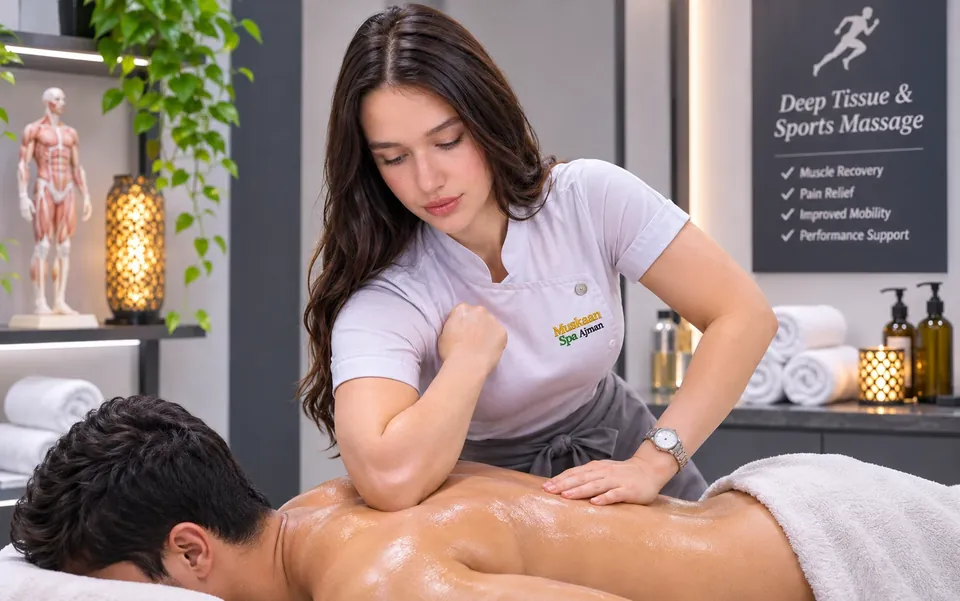
Who books a deep tissue massage?
The guests who most often book deep tissue or sports massage at our Ajman spa tend to fall into a few groups:
- Desk workers with stiff necks, rounded shoulders and tight upper backs from long hours at a screen.
- Drivers and commuters who spend hours on the road between Ajman, Sharjah and Dubai.
- Gym-goers and sportsmen who train regularly and want to look after tired muscles.
- People with physical jobs who stand, lift or carry for much of the day.
- Experienced massage guests who simply prefer firm pressure.
If you see yourself in that list, deep tissue massage may suit you. If you're new to massage, or mainly want to relax and drift off, a Kerala massage is usually a gentler starting point.
What does deep tissue massage feel like?
Honestly? It feels firm. You'll notice the pressure, especially in the areas that are tightest. Many guests describe a "good pain", an intense but satisfying sensation that eases as the muscle relaxes. It should never feel sharp, stabbing or unbearable.
Here's what usually happens:
- Warm-up. The therapist starts with broader, lighter strokes to warm the muscles.
- Gradual depth. Pressure builds slowly. Good deep tissue work is gradual, not sudden.
- Focused work. The therapist spends time on specific tight areas, using slow strokes or sustained pressure.
- Easing out. The session finishes with lighter strokes to help the body settle.
Communication is everything
The single most important thing in a deep tissue massage is telling your therapist how the pressure feels. Use a simple scale: if 1 is very light and 10 is too much, most people are comfortable at around 6 to 7. Say "a bit more" or "a bit less" whenever you like. You won't offend anyone, and the therapist would much rather adjust than have you tense up, which makes the massage less effective.
Is deep tissue massage painful?
It can be intense, but it shouldn't hurt in a way that makes you hold your breath or pull away. If you find yourself clenching or holding your breath, the pressure is too strong. Speak up.
Some guests feel mild soreness for a day or two afterwards, similar to the feeling after a hard workout. That's common, especially after a first deep tissue session or if you haven't had a massage in a long time. Soreness that's severe, lasts longer than a couple of days, or comes with swelling or bruising isn't normal. If that happens, speak to a doctor.
Deep tissue and sports massage
When deep tissue massage isn't the right choice
Firm pressure isn't suitable for everyone. Please speak to your doctor before booking if you:
- have a recent injury, sprain, strain or surgery;
- have blood clots, a bleeding disorder or take blood-thinning medication;
- have a heart condition, high blood pressure or diabetes affecting your circulation;
- have osteoporosis, a hernia, or any joint or spinal condition;
- have a skin condition, open wound or rash in the area to be massaged;
- have a fever or feel unwell.
Massage is not a substitute for medical care, and we don't treat injuries. If you have ongoing pain, a physiotherapist or doctor is the right first stop. Once they say massage is fine, we'll be happy to see you.
What happens during your session at Muskaan Spa?
Booking
Message us on WhatsApp or call. Tell us you'd like a deep tissue or sports massage, your preferred time and session length, and which areas feel tightest. Mention any injuries or health concerns now.
Arrival and consultation
Arrive around ten minutes early. After a quick welcome, your therapist will ask where you feel tight, what activities you do, how you feel about firm pressure and whether there's anywhere to avoid. This conversation shapes the whole session.
The massage
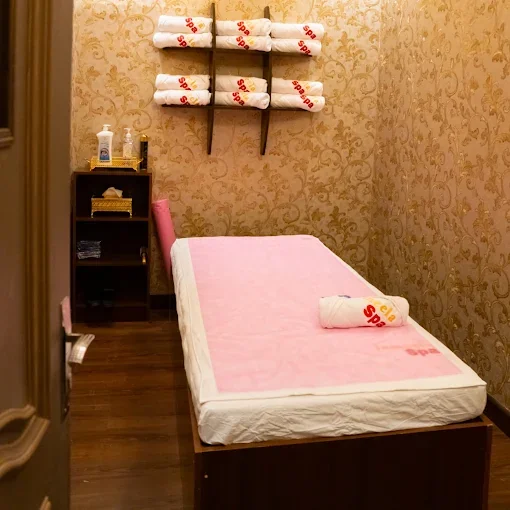
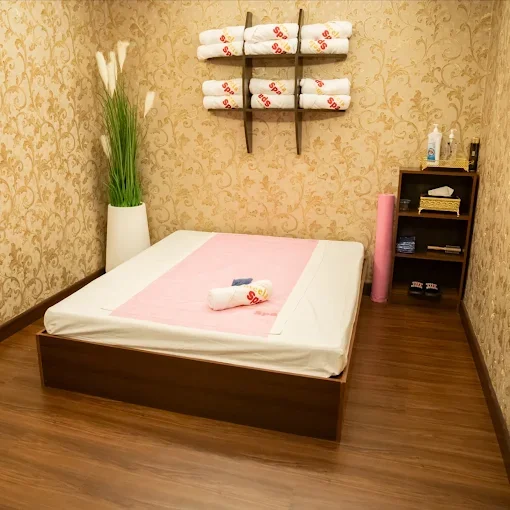
You'll lie on a massage table, covered with towels, in a private room. Only the area being worked on is uncovered. The therapist will warm up the muscles, then gradually work deeper into the areas you've discussed. Expect them to check in on pressure, and feel free to speak up at any time.
After the session
Take a moment before getting up. Drink water. Your muscles may feel warm, loose and a little tender. That's normal.
Making the most of your deep tissue massage
- Be specific. "My right shoulder and between my shoulder blades" is more useful than "my back".
- Breathe. Slow breathing helps your muscles let go of pressure.
- Don't try to be tough. Asking for less pressure isn't a weakness. It gets you a better massage.
- Hydrate. Drink water before and after your session.
- Rest the area. Avoid training the same muscle group hard for the rest of the day.
- Book regularly if it helps. Some active guests book every few weeks, others only when they feel tight. There's no rule.
Pairing with training
If you train in the gym or play sport, a sports massage can fit into your routine. Many people prefer a massage on a rest day, or a day or two after a heavy session, rather than right before training or competition. Talk to your coach or physiotherapist if you're following a structured programme.
Video coming soonBack and shoulder focus
The most requested area by far is the back and shoulders. Long hours at a laptop or behind the wheel tend to pull the shoulders forward and tighten the upper back and neck. If you'd like the whole session focused there, just ask. Your therapist can spend most of the time on the upper body and finish with the legs, or skip them entirely.
How long should the session be?
Deep tissue work is slow, and the therapist needs time to warm the muscles before working deeper. A shorter session works well if you want to focus on one area, such as the back and shoulders. A longer session leaves room for both the upper and lower body. Current session lengths and prices are on our massage prices page.
Comparing your options
| If you want… | Consider |
|---|---|
| Firm work on specific tight muscles | Deep tissue massage |
| Firm work shaped around training | Sports massage |
| Stretching and pressure, clothed | Thai massage |
| Full relaxation with warm oil | Kerala massage |
Still unsure? Our guide How to choose a massage center in Ajman walks you through the questions to ask, or you can simply message us and describe how you feel.
Deep tissue massage myths
"The harder, the better." Not true. Pressure beyond what you can relax into makes your muscles tense up, which works against the massage. The best pressure is the firmest level you can still breathe through comfortably.
"If it doesn't hurt the next day, it didn't work." Also not true. Some guests feel mild tenderness after a firm session, but many feel no soreness at all and still feel the benefit.
"Deep tissue is only for athletes." Many of our deep tissue guests have never set foot in a gym. They simply sit, drive or work long hours and prefer firm pressure.
"Deep tissue fixes injuries." It doesn't. Massage is a wellness treatment. Injuries need assessment by a doctor or physiotherapist.
Deep tissue for drivers and commuters
Hours behind the wheel, especially in stop-start traffic between Ajman, Sharjah and Dubai, tend to tighten the neck, upper back and hips. If that's you, ask for a focus on the shoulders, upper back and lower back. Many commuters find a session at the end of the working week helps them start the weekend feeling looser.
Combining deep tissue with other styles
Some guests like firm work on the back and shoulders but a gentler touch elsewhere. Just ask. Your therapist can use deep pressure where you need it and lighter, flowing strokes on the rest of the body.
Our standards
Every deep tissue and sports massage at Muskaan Spa takes place in a private, clean room with fresh towels and linens. Our team follows clear professional standards and will always explain the session before starting. Read about our approach on the About Muskaan Spa page.
Licence, hygiene and house rules
Licence
Muskaan Spa holds Ajman DED trade licence no. 130454 and offers professional, non-sexual wellness massage only.
Hygiene
Fresh towels and linens for every guest, tables and surfaces sanitised after every appointment, hands washed before and after every massage.
House rules
- Book ahead. Book on WhatsApp or by phone. Walk-ins are welcome when a room is free.
- Arrive 10 minutes early. Late arrival may shorten your session so the next guest isn't kept waiting.
- Professional massage only. Muskaan Spa offers professional, non-sexual wellness massage. Any inappropriate request ends the session immediately, with no refund.
- Respect for everyone. Abusive or disrespectful behaviour towards our team or other guests is not accepted.
Map and directions
Muskaan Spa Ajman - Massage Centre & Relaxation
Al Rashidiya 2, Ajman, United Arab Emirates
GPS: 25.39647, 55.44520 · info@muskaanspaajman.ae
- From Ajman: head to Al Rashidiya 2 and follow Google Maps to "Muskaan Spa Ajman".
- From Sharjah: Ajman borders Sharjah, so most guests drive straight across. Tap "Get directions" for the fastest route from where you are.
- From Dubai and Umm Al Quwain: use the directions button; travel time depends on traffic.
- Not sure where to park? Message us on WhatsApp when you arrive and we'll guide you.
- Open: 24 hours, 7 days a week.
The map loads only when you tap, to keep this page fast and private.
Frequently asked questions
Yes. Muskaan Spa offers deep tissue massage at our spa in Ajman. It uses slow, firm, focused pressure on tight areas such as the back, shoulders and legs. Book by WhatsApp or phone.
Yes. We offer sports massage alongside deep tissue massage. It uses similar firm techniques, shaped around the muscles you use in training or sport.
It can feel intense, but it shouldn't be painful. Tell your therapist how the pressure feels throughout. Most people are comfortable at a strong-but-manageable level.
Mild soreness for a day or two is common, especially after your first session. Severe or lasting pain, swelling or bruising isn't normal. Speak to a doctor if it happens.
Please speak to your doctor or physiotherapist first. Massage isn't a treatment for injuries, and firm pressure on a recent injury may not be appropriate.
Yes. Tell us when you book or at the start of your session, and your therapist can spend most or all of the time on your back, shoulders and neck.
Many people prefer a sports massage on a rest day or a day or two after a hard session, rather than right before training. If you follow a structured programme, check with your coach.
Deep tissue massage uses slow, firm pressure on specific muscles, usually with oil. Thai massage combines rhythmic pressure with assisted stretches and is usually done clothed.
There's no fixed rule. Some active guests book every few weeks, others only when they feel tight. Listen to your body, and follow any advice from your doctor.
Send us a WhatsApp message or call us with "deep tissue" or "sports massage", your preferred date and time, and the areas you'd like us to focus on.